
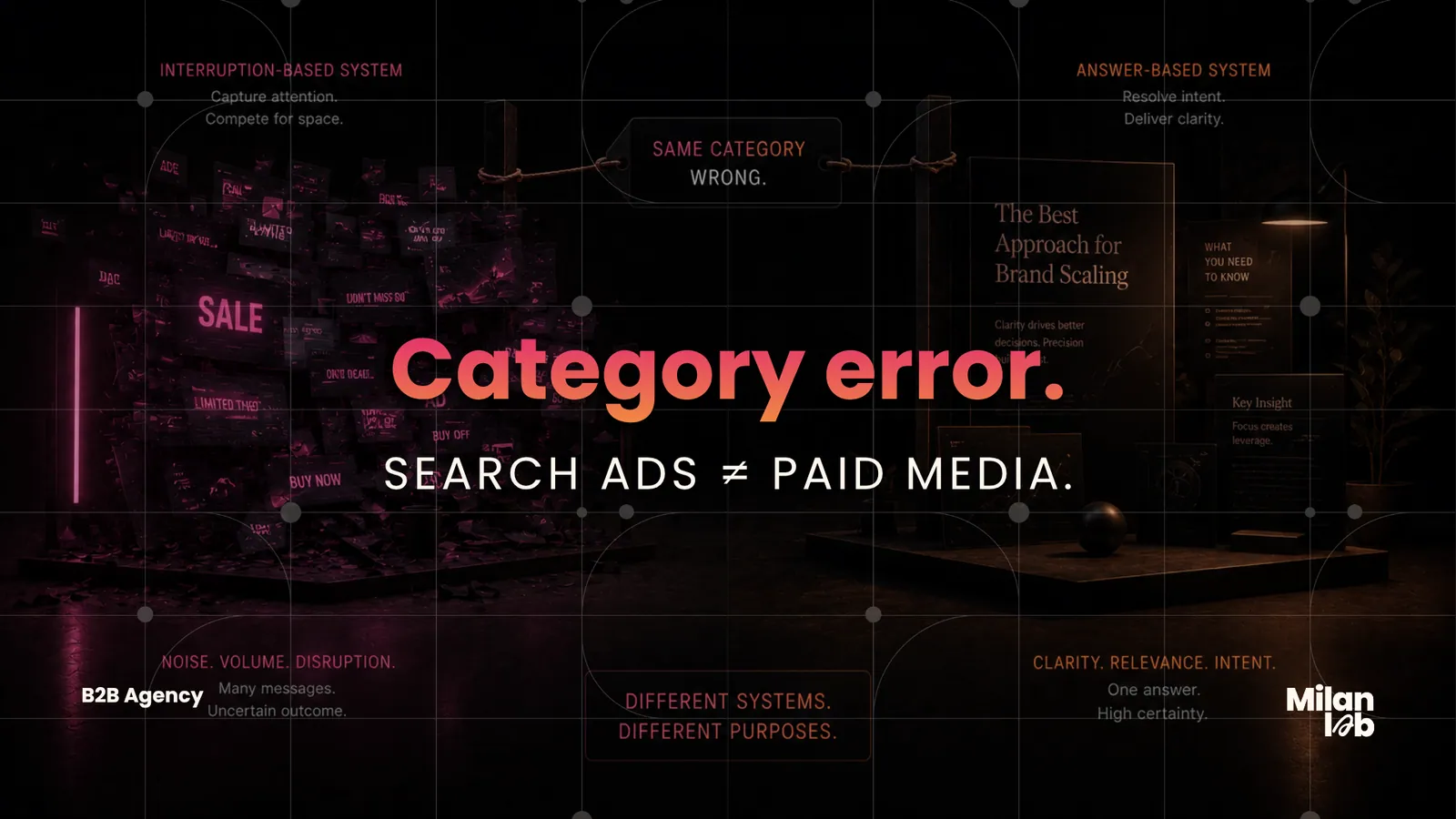
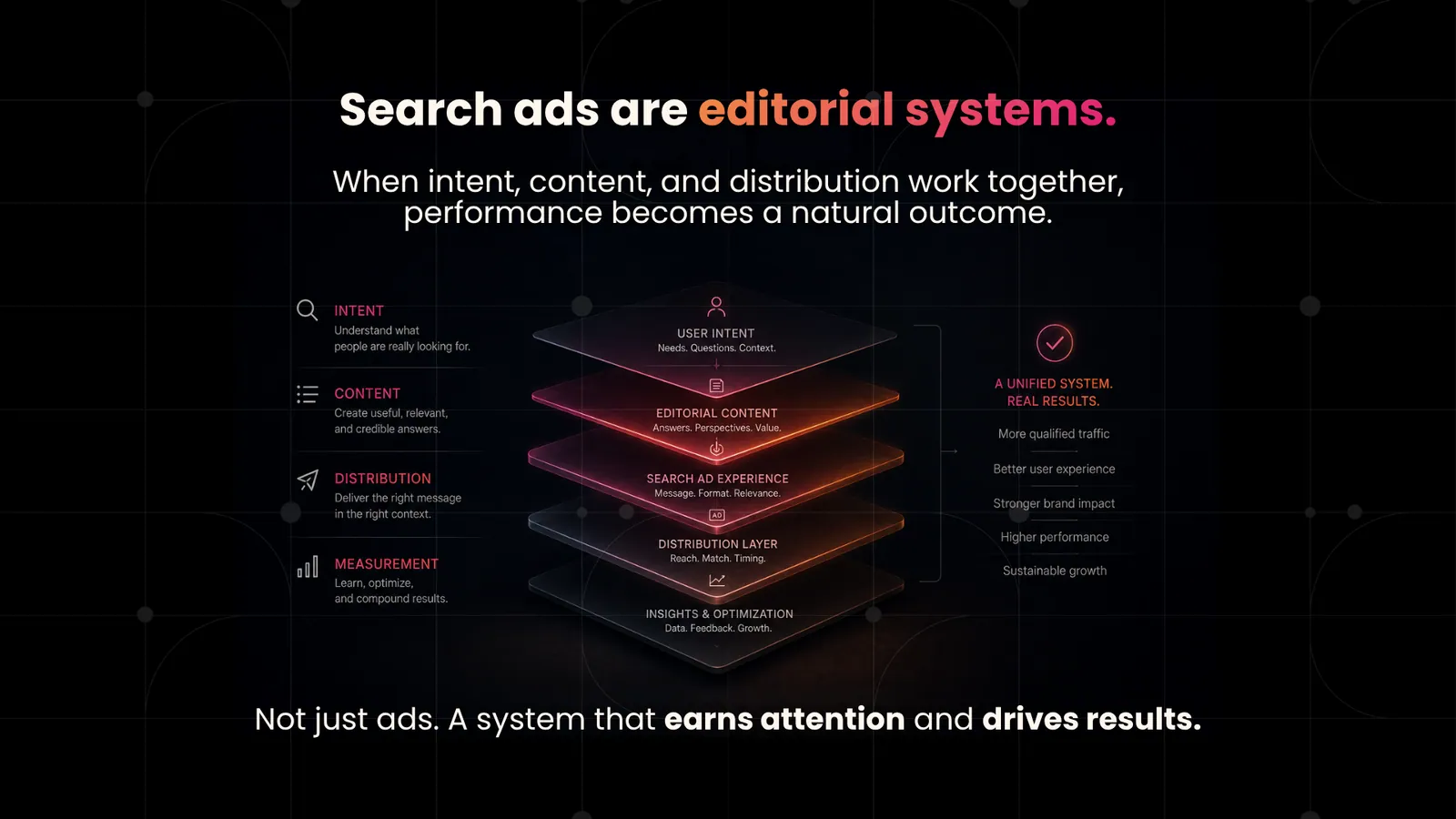
Search ads aren't a paid media product. They're an editorial product with a paid distribution layer.
Search ads aren't a paid media product. They're an editorial product with a paid distribution layer.
Why almost every brand is building them backwards, and why AI search is about to make that mistake much more expensive.
There's a number that gets quoted in every search marketing presentation and almost nobody stops to think about what it actually means.
The average conversion rate for search ads sits around 7.5 percent. The average conversion rate for display ads sits around 0.46 percent. That's not a small difference, it's a 16x gap between two channels that sit in the same line of the marketing budget.
Most teams hear that number and conclude that search ads are simply more effective. That may be true, but it misses the more interesting question: why are they more effective? And what does the answer mean for how the work should actually be organized?
The answer is that search ads and display ads are not the same category of product, even though they get treated as one. To be honest, confusing the two is why most brands underperform on search even when they're spending heavily on it.
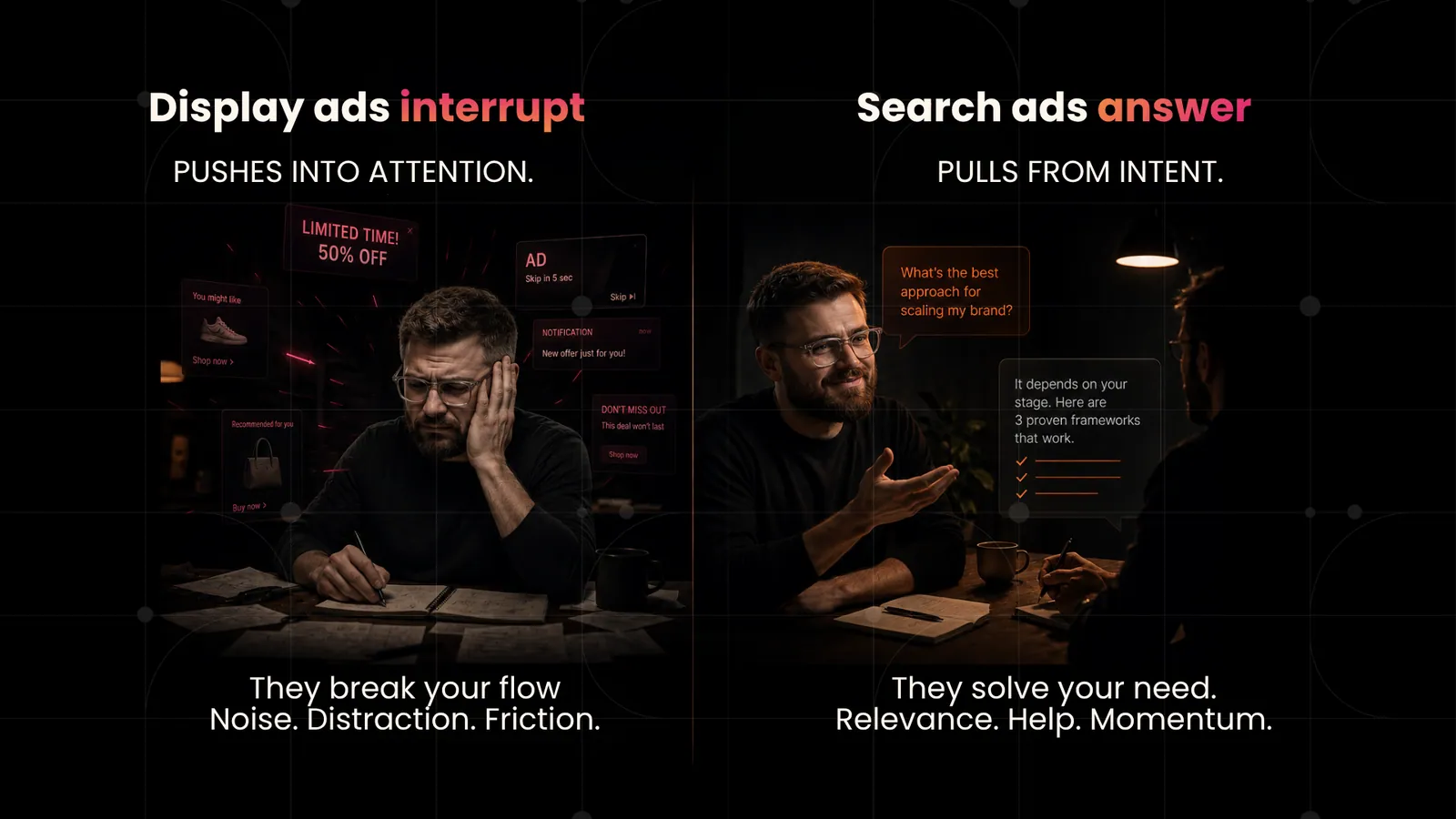
A display ad interrupts the user's attention, and then a search ad answers it. Those are not variations of the same thing, they are opposite jobs.
The category error nobody talks about.
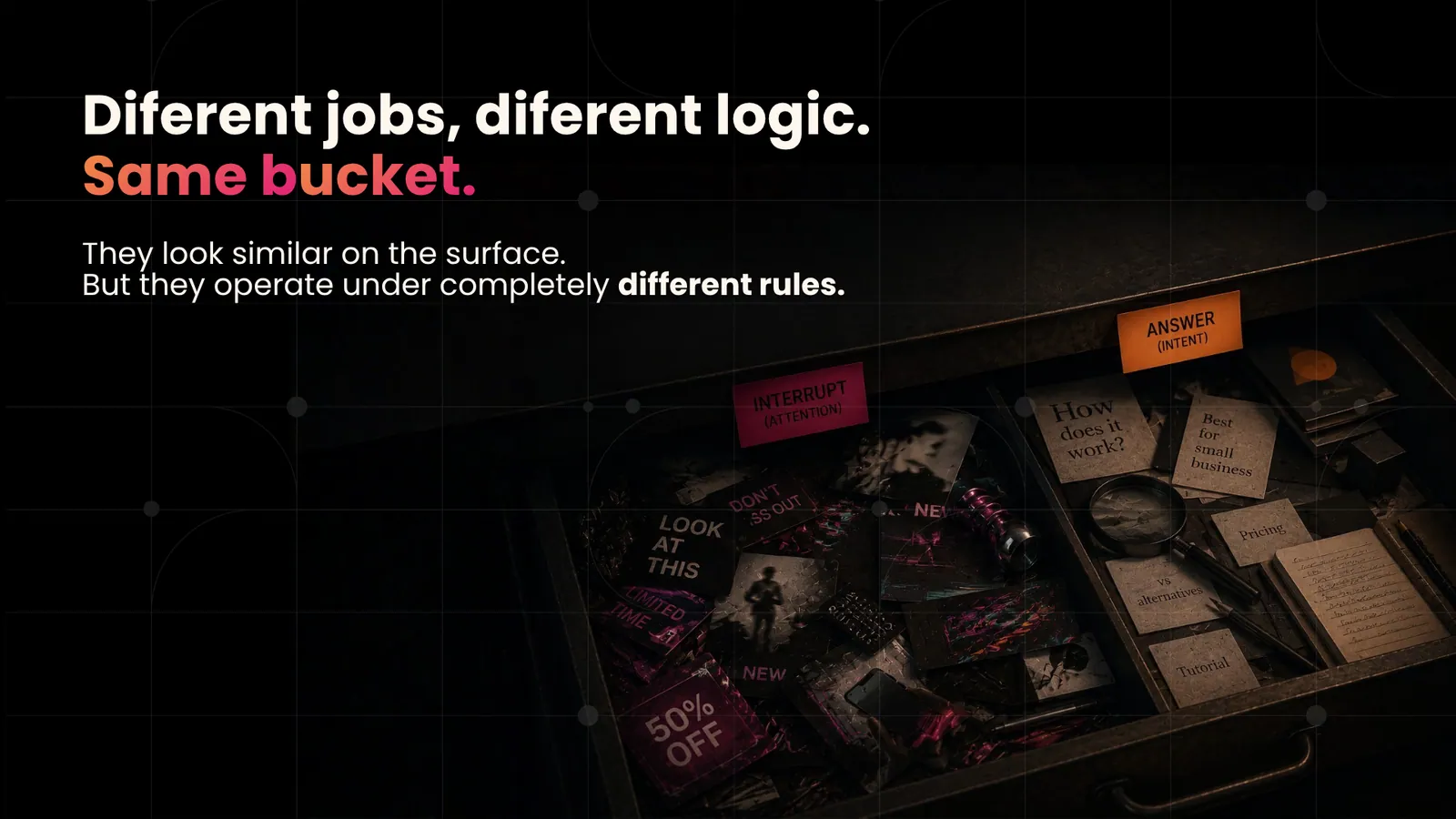
Inside almost every marketing org, paid media is treated as one discipline. There's a paid media team, a paid media budget, paid media KPIs, paid media reporting. Display, social, programmatic, and search all sit under the same umbrella, optimized by the same people using the same logic.
That structure made sense when search was a smaller channel, but it doesn't make sense anymore. Global spend on search ads passed 355 billion dollars in 2025, and the gap between how it should be managed and how it's actually managed has become one of the most expensive operational mistakes in modern marketing.
The problem is that display, social, and programmatic ads all share a fundamental dynamic: they interrupt someone who didn't ask. The job of the ad is to win a slice of attention that wasn't being offered. Creative needs to stop the scroll, messaging needs to be compressed, and the audience is built by the advertiser, not chosen by the user.
Search ads work in the opposite direction. The user has already raised their hand, typed the question, and is actively looking for a response. The job of the ad isn't to interrupt anyone, it's to be the answer the person was already looking for. That changes everything downstream.
When teams trained on display logic run search campaigns, they bring the wrong instincts: clever copy, brand-focused messaging, creative that draws attention. None of that is what wins on search. What wins on search is a precise match between the query and the response. That match is editorial work, not creative work.
Why most keyword research is structurally broken.
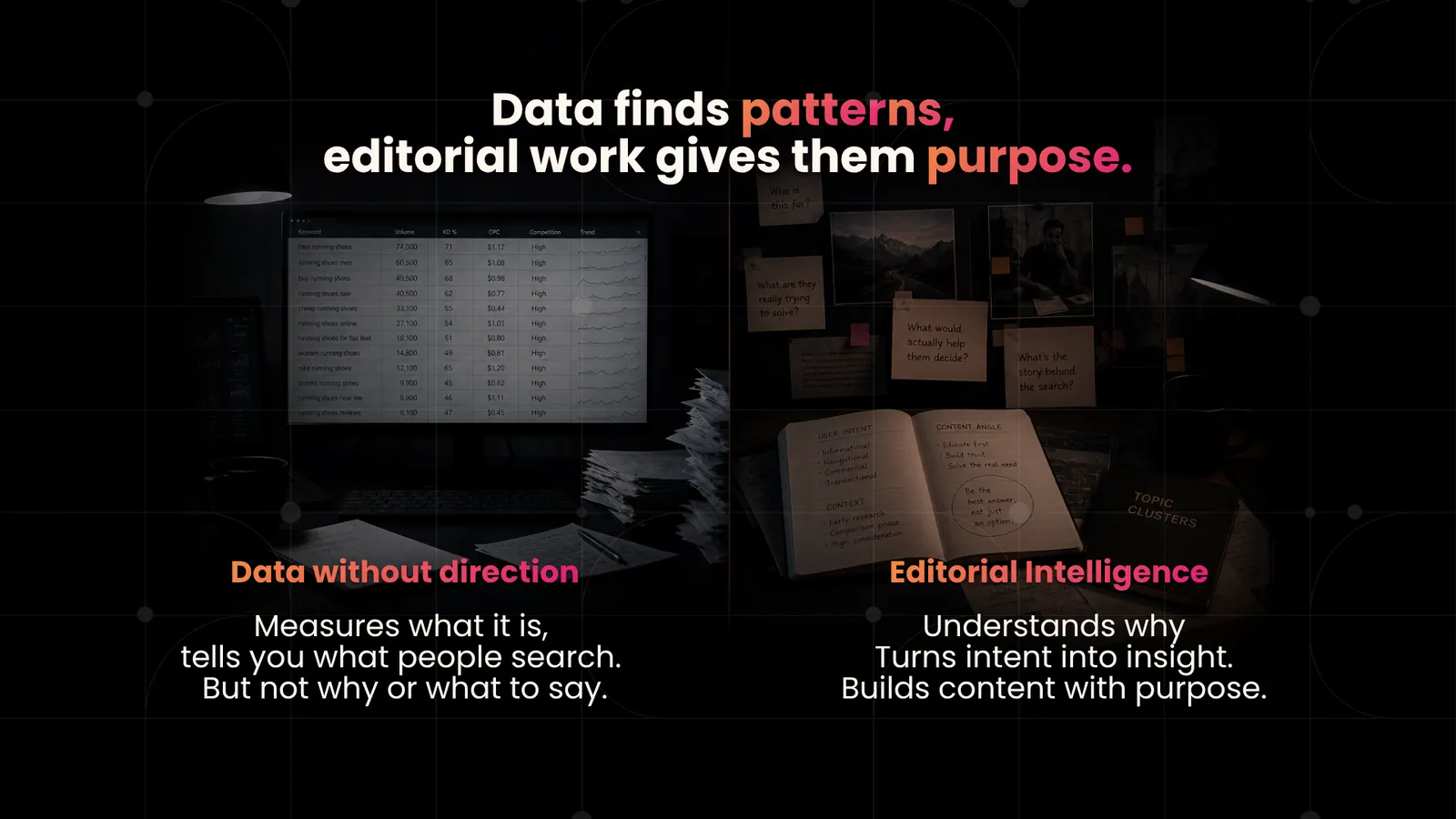
If search ads are an editorial product, then keyword research is editorial work. Once you accept that framing, the way most teams do keyword research starts to look strange.
The standard process is quantitative: you pull volumes, check CPCs, map difficulty scores, build a list. The list gets sorted by some combination of these metrics and the campaign gets built around the top entries. This is how most agencies do it, how most in-house teams do it, and how most SaaS tools are designed to support it.
What this process completely misses is intentionality. Two keywords with identical search volumes can represent different states of mind. Someone searching "how does X work" is in a different place than someone searching "buy X near me." One is learning, the other is ready to act. They need different content, different ad copy, different landing pages, different next steps. Treating them as comparable items on a list, ranked by volume, is a structural error.
In a newsroom, no editor would write a story without first thinking about who's going to read it, why they're going to read it, and what they need to take away. That same thinking is what's missing from most keyword research. The query is treated as a data point instead of as a window into a person's intent at a specific moment.
This is why search campaigns built off pure quantitative keyword research tend to bid on a lot of high-volume terms that look attractive but convert poorly. The volume is there, but the intent behind the query doesn't match what the brand is actually offering. The match fails before the auction even starts.
Keyword research isn't analytical work, it's editorial work disguised as data analysis. Almost every team does it without anyone who actually thinks like an editor.
The landing page nobody designed for the query.
Even when the keyword research is good and the ad is well-built, most search campaigns hit a wall at the destination. The user clicks because something in the ad signaled "this is what I was looking for." Then they land on a homepage, or a generic product page, or a landing page built for a different campaign.
The promise the ad made gets broken in the first two seconds after the click. The user doesn't bounce because they changed their mind, they bounce because the page didn't confirm what the ad told them they would find.
This is one of the most consistently expensive mistakes I see across brands of every size. The bounce rate on search ads landing on generic homepages tends to run three to five times higher than the bounce rate on search ads landing on content specifically built to answer the query. The bidding can be perfect, the creative can be sharp, the targeting can be exact, but none of it matters if the destination doesn't deliver the answer the click promised.
Here's the part that connects back to the editorial framing. Building destinations that answer specific queries isn't a paid media job, it's a content production one. It requires the same editorial thinking that goes into deciding what articles to write, what angle to take, what structure to use. The teams that run search ads as if they were paid media tend to skip this work entirely because it doesn't fit inside their discipline.

So why does almost everyone keep doing it the same way?
There's a question that I rarely see addressed in the writing on this topic, and it's the one that actually explains the whole situation. If the gap between how search ads should work and how they're being run is so visible, and the financial cost is so high, why does almost the entire industry continue building them the wrong way?
The honest answer is that doing it correctly is more expensive and slower in the short term, and most organizations are not structured to absorb that trade-off.
Building a content layer before you run paid takes time. Editorial keyword research takes time. Producing destinations that actually answer specific queries takes time. None of this is hard intellectually, but it requires upfront investment that doesn't produce a campaign you can point to in the next quarterly review. A generic ad pointing at a homepage, on the other hand, can be live by Friday.
There's also an internal politics layer that I think gets ignored in most strategy conversations. A paid media manager who runs a quick campaign has something to show in the next meeting: impressions, clicks, conversions, optimization runs. A manager who says we need three months of editorial work before the campaign starts has nothing to show on Monday. Internally, the first one looks productive and the second one looks like they're stalling, even though over twelve months the second approach almost always outperforms the first by a wide margin.
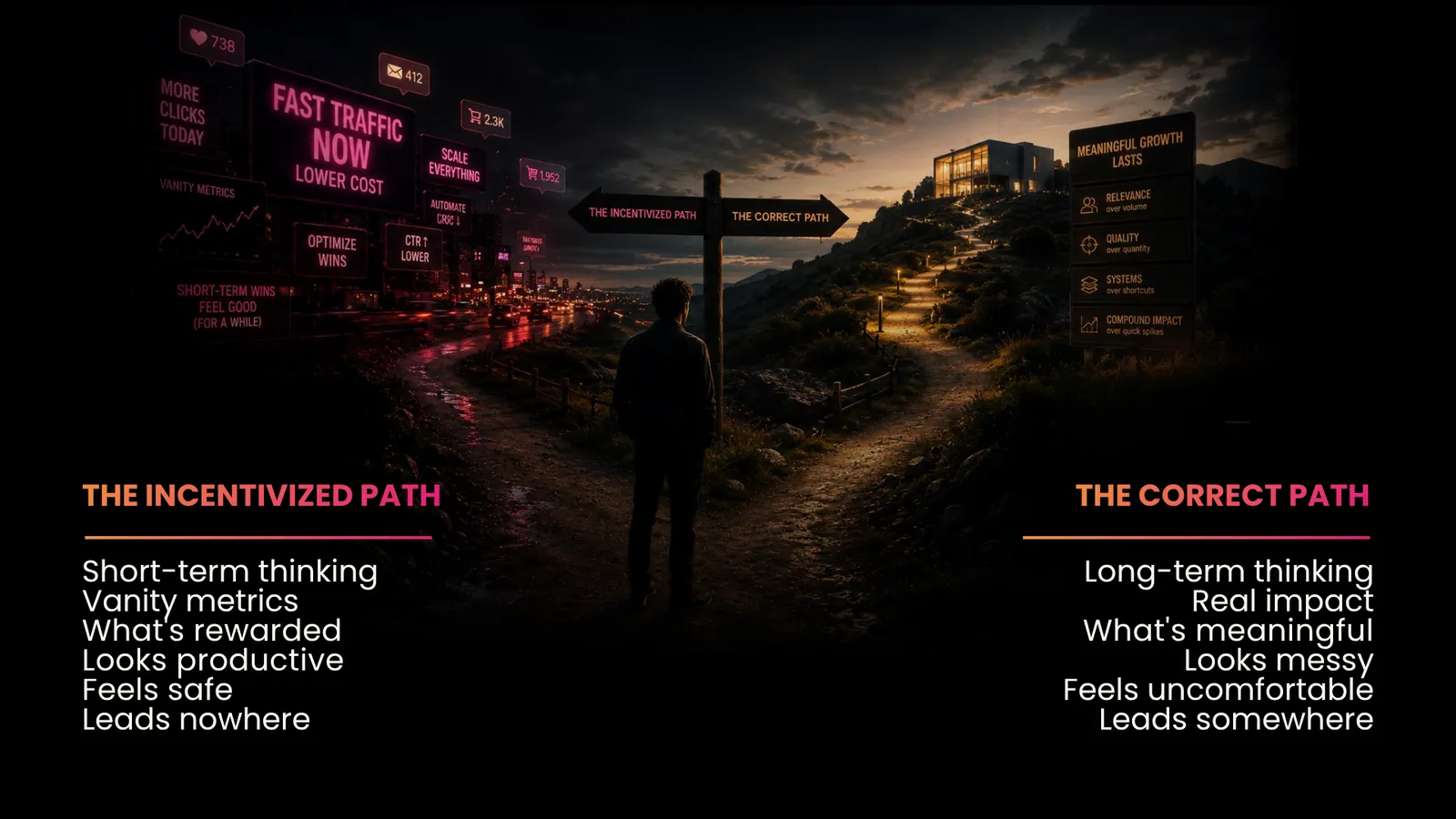
Quarterly KPIs make this worse. Most organizations measure paid media performance on quarterly windows, which structurally rewards quick activations and punishes the kind of editorial work that compounds over a year. The system isn't broken by accident, it's broken because the incentives inside the system reward the cheaper, faster, worse-performing version of the work.
None of this means the people running campaigns this way are wrong individually. Most of them know exactly what's happening. They're making the most defensible decision they can inside the constraints they actually face. The problem isn't with their judgment, it's with the constraints. And the constraints don't change until leadership decides to measure search performance on different timeframes and with different criteria.
The wrong approach isn't winning because nobody noticed it's wrong. It's winning because the right approach is more expensive in exactly the dimensions most organizations are structured to optimize against.
Why AI search is about to make this much worse.
Everything I've described so far is already costing brands money, but the model of search behavior that search ads were built for is starting to shift in ways that will make these errors much more expensive over the next two to three years.
AI search engines (ChatGPT, Perplexity, Google's AI Overviews, and a growing list of others) are changing how people look for information. The short, fragmented queries that classical search was optimized for ("best running shoes 2025," "plumber near me," "how much vitamin D") are giving way to longer, more conversational questions. People are asking AI assistants the way they would ask a knowledgeable friend, in full sentences, with context, expecting a structured answer rather than a list of links.
This shift has three consequences that are going to reshape the search ad market quickly.
First, the volume on short-tail keywords is going to keep eroding. People who get a good answer from an AI engine don't keep searching. The traditional funnel that brought users from a short query to a longer one to a final destination is getting compressed, and a lot of mid-funnel search ads are going to lose their natural audience.
Second, conversational queries don't map cleanly to the existing bidding model. You can't bid on every possible long-form question someone might ask. The market is going to move toward broader topical authority and away from precise keyword targeting, which is exactly what brands without strong content layers are unprepared for.
Third, AI engines extract information from content, they don't just point to it. If your content isn't structured to be the source of an AI answer, your brand becomes invisible in that channel. The brands that invested in deep editorial coverage of their categories are about to see compounding returns, and the brands that only invested in ad budgets are about to discover that ad budgets don't transfer well to AI search.
The brands that spent the last five years building a real content layer are going to look prescient. The ones that didn't are going to spend the next five years trying to catch up.

What changes operationally when you take this seriously.
The teams that perform consistently well on search ads aren't the ones with the largest budgets or the most sophisticated bidding strategies. They're the ones where the work is organized in a way that reflects what search ads actually are.
That means a few things in practice. The keyword research happens before the campaign exists, and the people doing it think like editors, not like analysts. The content layer gets built first, with destinations designed to answer specific queries, and the ads are built on top of that layer to point traffic at it. Campaign performance gets reviewed not just on click-through and conversion, but on whether the underlying content is earning the click independently of paid distribution.
This is roughly how we organize the work at Milan Lab when we run search-driven projects with partners. The content layer comes first, the keyword research is treated as editorial planning, and the paid distribution sits on top of an asset that has its own gravity. None of this is innovative on its own, what's unusual is doing it consistently, with the same team holding the editorial and the paid layers together as one product instead of two.
The reason it works is the same reason it's so hard to copy. It requires a team that understands both sides of the discipline well enough to make decisions across them. Most operations split these into two teams, two budgets, two reporting structures, and lose the connection that makes the whole thing work.
Search ads have been the most measurable, most efficient channel in digital marketing for two decades. That's true, but the way most brands run them treats them as if they were just another paid media product, and that misunderstanding has been quietly costing them performance the whole time.
The conversion rate gap that everyone quotes (7.5 percent versus 0.46 percent) isn't proof that search is magical. It's proof that answering someone who already raised their hand is fundamentally different from interrupting someone who didn't. Once you accept that, everything about how the work should be organized changes.
And the brands that figure this out now, before AI search shifts the model again, are going to have a window of advantage that most of their competitors won't even see closing.
The ones still treating search ads like display ads with better targeting? They're already losing, they just don't know it yet.
Working through this in your own operation?
It's the kind of problem we build teams to solve.
See how we work